


When you take an interest in aromatherapy or slow cosmetics, you realize the countless plants and their benefits for the body and health. While essential oils and plant oils are clearly distinct, the difference between floral water and hydrosol is less obvious. We will explain how to tell them apart and what to choose for your skin.

Hydrosol production: definition and explanations
Hydrosol is the liquid collected after steam distillation of a plant in a still. It is the water that remains after the essential oils have been separated.
At the end of the distillation process, the steam is cooled and then collected in liquid form in a settling vessel. It is at this point that the essential oils separate from the water and rise to the surface.
They leave behind a liquid loaded with aromatic molecules at a lower concentration. This is why hydrosol has useful benefits in cosmetics, even though it is less intense than an essential oil.
However, it does not last as long as essential oils.
What is the difference between floral water and hydrosol?
Floral water and hydrosol are both produced by distilling plants.
The difference between floral water and hydrosol simply depends on the plant that is distilled: a flower for the former and a plant for the latter.
The two terms are often confused, either through loose usage or a lack of awareness of this small distinction.
When to use floral water and hydrosol?
These natural products can be used daily:
- to cleanse the skin instead of tap water
- to provide a little morning freshness, for example
- to target a particular skin problem
- to replace tap water in homemade cosmetics
Hydrosols and floral waters have the same properties as essential oils, despite their lower concentration of active ingredients.
This gives them a major advantage: they are easy to use in daily skincare because they are well tolerated by all ages.
In contrast, essential oils have many contraindications and must be used under more controlled conditions.
Floral water or hydrosol: which one should you choose?
You can choose your floral water or hydrosol according to your skin type and how you want to use it.
Do you want to combat a particular problem? Combine your floral water or hydrosol with another active ingredient? Add it to your cosmetic product to give it a pleasant scent and a few extra benefits?
Here are a few examples of floral waters and hydrosols you can choose according to the properties of each plant and your needs:
May rose hydrosol: for all skin types

Rose is particularly known for its soothing properties. May rose hydrosol also has many other properties that help firm and enhance the skin:
- Astringent and vasoconstrictive: it promotes blood circulation and tones the skin
- Toning: rose helps combat skin sagging and contributes to reducing the signs of aging
- Anti-inflammatory: it soothes tension and redness by acting on the nervous system
Rose hydrosol is also lightly scented, which makes it appealing to incorporate into homemade skincare in addition to its properties.
Cucumber hydrosol for oily or dull skin

When we think of cucumber and skincare, we all imagine putting slices on our eyes or face. But doing that every morning is not very practical. That is why cucumber hydrosol exists.
Obtained through hydrodistillation, the liquid is rich in vitamins, minerals and enzymes and also has interesting properties for the skin:
- Brightening: the enzymes present in cucumber hydrosol act on melanin production. This helps even out the complexion and restore radiance to your skin.
- Antioxidant: it combats skin aging by fighting free radicals. It stimulates epidermal cell renewal thanks to the lactic acid it naturally contains.
- Purifying: it regulates sebum production
- Decongesting: cucumber is rich in vitamin C and can help reduce puffiness, for example around the eyes.
Cucumber hydrosol also promotes hydration and tones the skin. You can use it as a refreshing mist throughout the day, but also in homemade skincare or masks.
Keep it in the refrigerator to enhance its freshness, ideal during hot weather.
Hamamelis floral water for oily and problem skin

If you have skin prone to imperfections, witch hazel floral water can help you combat them thanks to its properties:
- Vasoconstrictive: it promotes blood circulation. Witch hazel is used for heavy legs, varicose veins and hemorrhoids, for example.
- Anti-inflammatory and soothing: it calms skin irritation caused by cold and wind. It can also help with insect bites and minor wounds by aiding healing.
- Astringent: it helps tighten pores. Floral water can dry out the skin and is therefore not ideal for dry skin.
Lavender floral water for normal and oily skin

In addition to transporting you to Provence, lavender floral water has many properties for both the skin and hair.
- Soothing and refreshing: it relieves, heals and soothes skin inflammation.
- Comforting: its pleasant scent has a relaxing effect on the mind and helps reduce stress.
- Cleansing and purifying: it removes impurities, toxins and dead cells that clog pores. Lavender floral water therefore deeply purifies the skin.
Laboté floral waters for all skin types
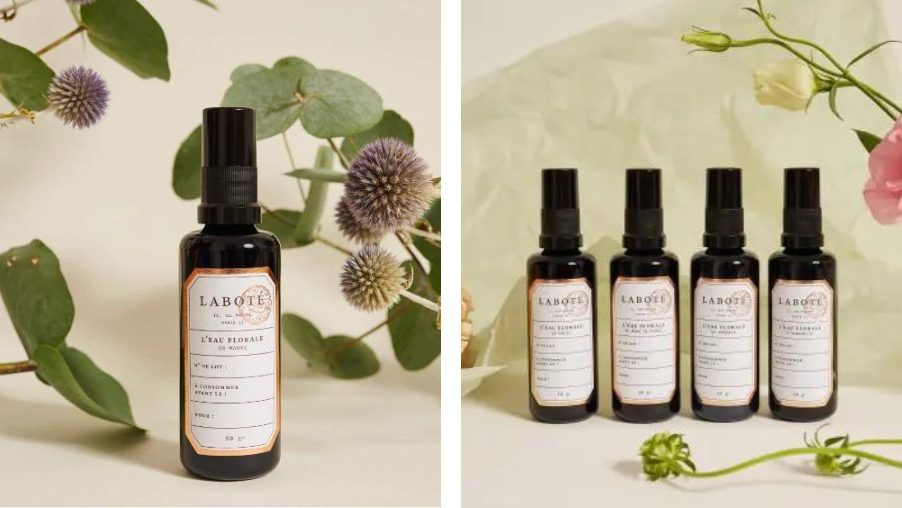
The Laboté floral water range was launched in 2018 and consists of 4 exceptional medicinal plants, selected for their complementary benefits for different skin types.
#1 - Soothing mallow floral water
- Soothing and anti-inflammatory: it reduces redness and soothes skin prone to inflammation.
- Comforting: its soft, natural scent gives the skin a fresh sensation.
- Moisturizing: it tones and promotes skin radiance.
#2 - Antioxidant Damask rose floral water
- Moisturizing and toning: it leaves the skin fresh and radiant.
- Soothing: it calms irritation and redness.
- Regenerating: it helps regulate sebum and reduces the signs of aging.
- Its delicate scent: provides a refreshing and relaxing effect.
#3 - Purifying rosemary floral water
- Purifying: it deeply purifies the skin and regulates excess sebum.
- Toning and refreshing: it tightens pores and is ideal for combination to oily skin.
- Stimulating: also serves as a revitalizing tonic.
#4 - Vein-toning witch hazel floral water
- Toning and vasoconstrictive: it promotes blood circulation, helping to reduce redness and the sensation of heavy legs.
- Refreshing and comforting: it supports vascular health.
- Soothing and revitalizing: it soothes couperose and provides a feeling of lightness.
As you may have realized: every floral water and hydrosol has many natural properties derived from the plants they are extracted from.
These 3 plants are just a small handful of the plants used in aromatherapy and natural cosmetics.
To know them all, you would need an entire book. But to see things more clearly in a simple and concise way, here is a non-exhaustive guide in the form of an infographic, created by us:

And what plants do you use? Feel free to tell us in the comments.
If you are interested in slow cosmetics, Meanwhile Boutique has a collection dedicated to natural and organic cosmetics. Hydrosols, floral waters, essential oils, shea butter... the brands in the collective are highly transparent about the composition, production and origin of the plants. As an added bonus: none of the products are derived from or tested on animals.
Sources:
Slow cosmetics website blog
Cosmebio label website
Slow cosmetics website blog
Cosmebio label website


