


"Zero plastic, zero toxins". That is the title of Aline Gubri's book. In her book, the author shares her tips for minimizing plastic waste and living a responsible lifestyle without accumulating unnecessary waste on a daily basis.
Like many, the young woman is a zero plastic enthusiast. But what does it involve? Why and how to adopt this concept in everyday life? After craftsmanship, we will explore zero plastic together, one of the 17 key values that make up Meanwhile Boutique's committed charter.
Zero plastic: what is it?

Zero plastic is very close to zero waste. Both start from the same principle: to no longer produce waste. However, zero plastic is an approach that aims to reduce, or even completely stop using, plastic on a daily basis.
Very cheap and durable, this material is ubiquitous in everyday life. Water bottle, single-use bag, disposable tableware... Plastic makes up the majority of single-use products available on the market. To counter this disposable industry, zero plastic encourages the use of more responsible, durable, and environmentally friendly alternatives. This notably involves the use of reusable materials such as glass, metal, wood, bamboo, or other natural elements. The goal of this eco-responsible concept is to reduce the amount of plastic waste generated in nature, limit ocean pollution, and preserve ecosystems.
The impact of plastic on the environment
Plastic is really not fantastic... It is also one of the most widespread types of waste in the marine environment. Today, it is estimated globally that the amount of plastic in the oceans ranges from 75 to 199 million tons and that 24.4 trillion microplastic particles are floating on the surface of the oceans*. These staggering figures have only increased due to the consumption of masks and gloves because of the Covid-19 pandemic.
Significant environmental pollution
Plastic consumption has quadrupled in just 30 years. The cause? The growth of emerging markets. Food packaging, ready-to-wear, automotive, construction... Valued for its practicality and accessibility, this material is recommended by many industries. From 2000 to 2019, nearly 460 million tons of plastic were produced by humans.
However, its production is far from being environmentally friendly. Plastic is mostly obtained from crude oil or natural gas, two non-renewable fossil fuels. Oil is extracted from the ground, then converted into polymer using heat and various additives in refineries. Its manufacturing process is one of the most energy-intensive in the world. As a result, plastic accounts for 3.4% of greenhouse gas emissions.**

Recycling: 100% (zero) plastic?
Although selective sorting is becoming increasingly common in households, not all plastic products are recyclable. This is the case for packaging that is too thin or too light, such as plastic film or plastic bags, which should not be thrown in the yellow bin, but with household waste.
Of course, some bags and packaging can be placed in sorting bins. If a plastic product has a triangle-shaped logo with three arrows ♻️, it means it is recyclable.
However, another problem is added to the recycling question: the combination of different materials. When plastic is mixed with another material, recycling remains difficult, if not impossible. This is particularly the case with disposable cardboard cups, so-called "recyclable" due to their wood cellulose composition. Yet, most of these cups are not recycled because a layer of plastic ensures their watertightness. The complex composition of these products is difficult and costly to separate. Only a few factories process this type of waste in Europe.
Zero plastic goal: 3 good practices to achieve it
To counter all problems related to recycling, there are simple actions to gradually eliminate plastic from your daily life. Switching to zero plastic is a bit difficult at first and requires new organization and new habits. But that doesn't make it impossible. Moving forward step by step by giving yourself a new challenge every day is an excellent way to start.
Here are a few tips for switching to a zero-plastic lifestyle.
#1 - Carry your groceries differently
Before their ban in France, 5 billion single-use plastic bags were distributed at store checkouts every year. To do your shopping, an alternative was found: the reusable fabric tote bag. It is plastic-free and sturdier than a regular bag.
The creators of the Lebanese brand KEESS® are fighting against single-use plastic pollution in their country. To do this, they offer zero-plastic alternatives to minimize unnecessary waste.
 Zero plastic "Seashell" tote bag - €13
Inspired by the current situation in Lebanon, these young women are delivering a committed message on their organic cotton tote bag, which says in English, "Did you know that if you hold a seashell to your ear, you can hear the sound of a fish choking on plastic?".
#2 - Use biodegradable bamboo toothbrushes
This is one of the enemies when talking about plastic. According to statistics, around 5 billion toothbrushes are thrown away every year. Unfortunately, the majority have been designed using plastic.
Without a doubt, the wooden toothbrush is the most common alternative to counter the plastic toothbrush. And the zero-plastic French brand Oceansrespect has understood this very well.

Pack - Chewable solid toothpaste and bamboo toothbrush - from €9
It offers a toothpaste + toothbrush pack. The toothbrushes are made using bamboo and are available in several formats. The classic format (on the left in the image) has only one head. As for the interchangeable format (on the right in the image), the head can be replaced.
Beyond the durable aspect of these brushes, which allows you to use them longer than brushes made of plastic, they are biodegradable and therefore do not have a significant negative impact on the environment.
The toothpaste (mint/strawberry) that comes with the brush is 100% natural origin, developed and recommended by dentists.
#3 - Ban plastic containers in your bathroom
For a plastic-free bathroom, the first thing to do is to remove all shampoo and soap bottles from your shower. In recent years, more and more solid formats have been appearing on the market.
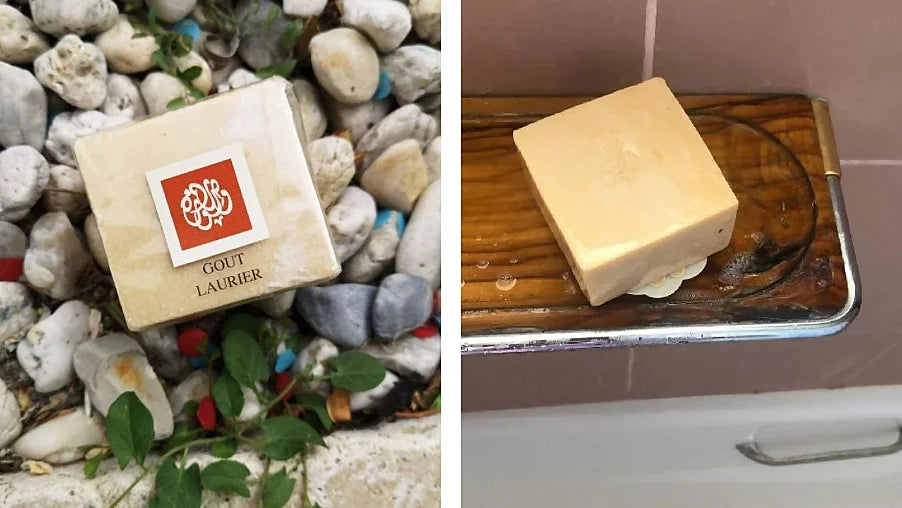 Solid organic soap I 2 scents - €5.90
The Lebanese brand Al Mansoura is one of the emerging solid care brands. It offers solid organic soaps for the body and hair with natural ingredients. The packaging is plastic-free.
Zero plastic is one of the pillars of Meanwhile Boutique. Through social networks, and more specifically guides on Instagram, we share good deals and tips for a more responsible daily life.
A sustainable world without waste is also one of the great goals of our committed brand collective. Thus, the creators are committed to offering ethical items for a plastic-free lifestyle.
Sources:
* Ministry of Ecological Transition and Territorial Cohesion, marine waste
** OECD, Plastic pollution continues to grow while waste management and recycling lag behind
UN, Everything you need to know about plastic pollution
BP France, How is plastic made?
Paprec, Plastic waste recycling: everything you need to know
Éco Conso, What are the limits of recycling?


